by Karen | Apr 24, 2018 | Karen's Korner
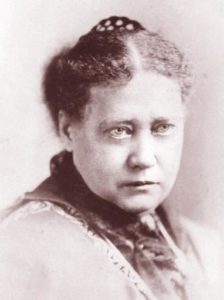
Helena Blavatsky was born in Ekaterinoslav, Russia in 1831, the daughter of Colonel Peter von Hahn and Helena de Fadeyev, a renowned novelist. At an early age, she was gifted as a linguist, pianist, artist, and naturalist. She also possessed psychic powers that puzzled her family and friends.
She married the middle-aged Nikifor V. Blavatsky, Vice-Governor of the Province of Yerivan when she was 17. The marriage was never consummated. After few months, she escaped and traveled to Turkey, Egypt, and Greece.
While in London in 1851, Blavatsky said she met Master Mahatma Morya. He informed her that she was destined for special work, and she accepted his guidance from that point onward. Her travels took her to North and South America, the West Indies, and Japan. While visiting Tibet, she was able to acquire some of her occult training with Master Morya. She then traveled to Russia for a time and visited the Balkans, Greece, Egypt, Syria and Italy and other countries. She returned to Tibet in 1868 and met Master Koot Hoomi for the first time. She said she stayed in his house in Little Tibet and studied clairvoyance, clairaudience and telepathy.
Blavatsky joined the Spiritualist movement in the early 1870s but didn’t believe that the entities contacted were the spirits of the dead. In 1874, she met Colonel Henry Steel Olcott, who had served in the U.S. Government and was practicing law in New York. She was also introduced to William Quan Judge, a young Irish lawyer. The three of them, along with other friends, founded The Theosophical Society in 1875. The society’s purpose was to “promulgate the ancient teachings of Theosophy, or the Wisdom concerning the Divine which had been the spiritual basis of other great movements of the past, such as Neo-Platonism, Gnosticism, and the Mystery-Schools of the Classical world.”
Blavatsky’s first book, Isis Unveiled, “outlined the history, scope and development of the Occult Sciences, the nature and origin of Magic, the roots of Christianity, the errors of Christian Theology and the fallacies of established orthodox Science.”
They established their Theosophical Headquarters and their first journal in Bombay in 1879. Although opposed by the British government, Theosophy spread rapidly in India, but not without problems. Blavatsky was accused of creating fraudulent paranormal phenomena. She remained a controversial figure during her lifetime, championed by supporters and derided as a fraudulent charlatan and plagiarist by critics.
In ill health, Blavatsky pushed onward. She wrote her second work, The Secret Doctrine, in 1884. Volume I concentrated on the evolution of the universe. Volume II discussed the evolution of humanity. In 1888 she formed the Esoteric Section of the Theosophical Society for the deeper study of the Esoteric Philosophy by dedicated students. In 1890, she established the European Headquarters of the society in London.
After completing two more books, Blavatsky died in London in 1891 during a flu epidemic.
For more information, see the Blavatsky Study Center.

by Karen | Apr 10, 2018 | Karen's Korner
Geoffrey Hodson was born in Lincolnshire, England in 1886. During his boyhood, he had several psychic experiences. It was during that time that he was contacted by a spirit which he would later identify as a Kundalini life force known as the Serpent Fire. In his early twenties, he studied spiritualism, but it was not the philosophy of life he was seeking. It wasn’t until he attended a lecture by Dr. Annie Besant in Manchester in 1912, that he found and joined the Theosophical Society.
World War I interrupted his search for the truth. He joined the Tank Corps as a Commander and was dispatched to France and Belgium in 1918. After the war, he married Jane Carter and joined the YMCA Secretariat. It was around this time he met Mrs. Mary De La Middleton who said that her spirit guide had instructed her to show Hodson how to awaken his abilities.
Hodson worked on his meditation skills and study of theosophy. He and Jane toured Lancashire on his motorcycle, making detailed notes on the various types of fairies and nature spirits Hodson perceived in each location. When they reached the valley of Sheepscombe, he was contacted by an angel named Bethelda and began working with higher spirits.
Seven orders of angels are mentioned in The Bible, but Hodson said there are many more. They act as “creative and directive intelligence behind various universal qualities such as love, music, power etc.” Instead of angel, which means messenger, he used the word “deva,” which is the Sanskrit term for a celestial or shining being, when describing them.
Hodson traveled around the world three times while lecturing for the Theosophical Society. His contact with Bethelda led to his meeting angels and other spiritual beings in every country that he visited. He said they recognized him as an “Ambassador between the Human and the Angelic Kingdom.” They offered their assistance and aided his investigations. On one occasion they helped with his healing work, curing not only those who came to him, but also renewing his own energy.
He considered fairies as “junior members” of the angelic kingdom. Although many thought fairies were mere fantasy, he figured they were so prevalent in fables of every country that they shouldn’t be disregarded. He described the appearance and function of nature spirits in his early books, Fairies at Work and at Play, 1925 and The Kingdom of Faerie, 1927. He was privileged to meet with the Maori Princess Te Puea, who also possessed mystical abilities. She taught him about the race of fairies known to the Maori as the Patupaiarehe in New Zealand.
Over his lifetime, Hodson wrote over 50 books on a variety of subjects and hundreds of articles about his investigations and the angelic teachings given to him throughout his life.
After spending long periods of his time in Australia and New Zealand, he eventually settled in Auckland and became a naturalized citizen. His last lecture was given when he was 96 years old, eight months before his death in 1983.
For more information see the Geoffrey Hodson Website.

by Karen | Apr 3, 2018 | Blog, Karen's Korner
Most often, we focus on methods and techniques to connect our Earthly plane to the spirit world. We don’t realize that the spirits must work to connect from their side as well.
In the book, The Blue Island, William T. Stead describes his process of reaching Earth from the spirit world. He first brings up the issue of time. On earth we are acutely conscious of the passage of time. The Earth’s orbit around the sun creates years. Its rotation divides those years into days and nights. People have subsequently divided days into hours, minutes and seconds.
He informs the reader that the spirit world has no such passage of time. “We have no dark sky,” he said. “only a light one, and we have, for the sake of the present illustration, an unlimited supply of energy. We do break up our time, but it is not your breaking, therefore we can seldom be accurate in telling when a thing did, or when a thing will, happen.”
William wrote of many buildings being present in the part of the spirit world in which he resided. One of those buildings was used to establish communications with the Earth. He said that it was a well-organized, very business-like place. There were hundreds of people there trying to get messages back home to loved ones. He referred to the messages as “heart calls.”
William said he expected the building to be equipped with different instruments to aid their communications but found none. “It was only the human element,” he wrote. Connection was achieved by thought.
On his first visit to the building, he had a long conversation with a mundane looking man. He was told that they had a system of travelers who worked very closely with the Earth. “They had the power of sensing people who could and would be used for this work at the other end.”
William visited the building frequently, trying to get messages home by more than one means. Sometimes he succeeded; sometimes he did not. “The spirit has much to do himself with the success or failure attained; a great deal depends upon him. Every time I succeeded I helped another.” When he did fail, he was given unlimited help by those working there.
He first successful communication was with a group of people holding a séance. “I had to visualize myself among these people in the flesh. Imagine I was standing there in the flesh, in the center of them, and then imagine myself still there with a strong light thrown upon me….Create a picture.”
The first time, none of his family were present and he made only his face visible to them. Later on, William became adept at communication, and through spirit writing, gave us the information contain in the book, The Blue Island.
Reference: Pardoe Woodman & Estelle Stead. The Blue Island. London 1922.