
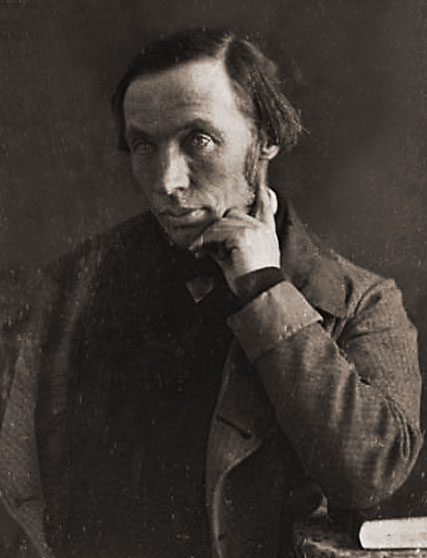
Robert Dale Owen was born in 1801, in Glasgow, Scotland, son of Robert Owen. He grew up in Braxfield and completed a formal education in order to join his father in the family business. His father was a textile manufacturer and social reformer who established Utopian communities in both England and the United States. Sharing his father’s views, Owen moved to the U.S. in 1825 and helped manage New Harmony, a community they started in Indiana.
Owen published articles in the New Harmony Gazette before the town dissolved its charter in 1827. Afterward, he traveled between Europe and the U.S. He wrote numerous articles and publications and co-edited the Free Enquirer, supporting many radical views at the time, including birth control, free public education, women’s rights and abolition of slavery.
Owen married Mary Jane Robinson in 1832 in New York City and they moved to New Harmony where they had six children. He became active in state politics a year later and served two terms as a member of the Indiana House of Representatives. He later served in the U.S. House of Representatives, worked as a diplomat in Sicily and Naples, and was on the Ordinance Commission for the Union Army. He retired from public service in 1864 and continued with his writing career.
Like his father, Owen was a Spiritualist. He wrote two books on the subject: Footfalls on the Boundary of Another World (1860) and The Debatable Land Between this World and the Next (1872).
In Footfalls on the Boundary of Another World, he discussed sleep, dreams, poltergeists, apparitions and changes at death. He believed that the spirit didn’t remain in the grave at death. Death only changes the body, not the heart or the mind. He also felt that spiritual change was a gradual one, like the changes we see in nature.
He wrote, “In other words, death destroys not, in any sense, either the life or the identity of man. Nor does it permit the spirit, an angel suddenly become immaculate, to aspire at once to heaven. Far less does it condemn that spirit, a demon instantly debased, to sink incontinently to hell.”
In 1875, Owen suffered a mental breakdown and was hospitalized for three months. After his recovery, he resumed writing and married his second wife, Lottie Kellogg. He died a year later, in June of 1877.
Additional Reading:
Gugin, Linda C., and James E. St. Clair, eds. (2015). Indiana’s 200: The People Who Shaped the Hoosier State. Indiana Historical Society Press, Indianapolis.
Leopold, Richard William (1940). Robert Dale Owen: A Biography. Harvard University Press,Cambridge, Massachusetts.
Owen, Robert Dale (1860). Footfalls on the Boundary of Another World. J.B. Lippincott & Co., Philadelphia.
Owen, Robert Dale (1874). Threading My Way, Twenty-seven Years of Autobiography. G. W. Carleton and Company; Trubner and Company, London and New York.
For more interesting blogs, see my collection: Treasures From the Spirit World.