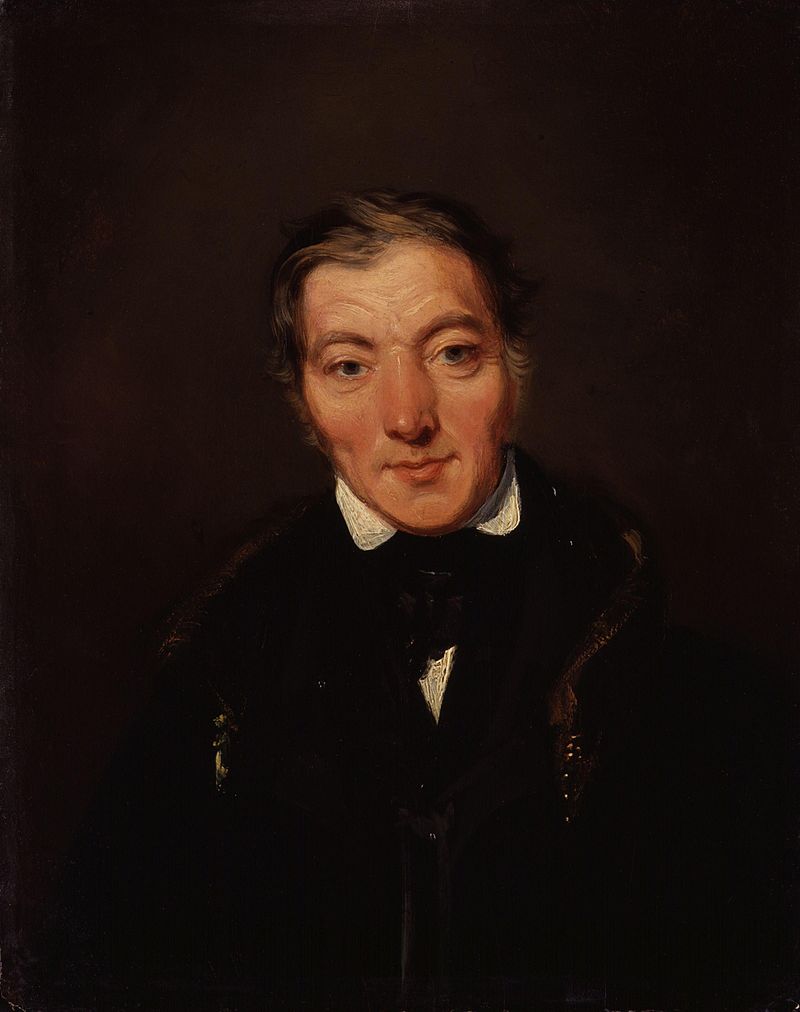
Robert Owen was born in Montgomeryshire, Wales in 1771, the sixth of seven children. His father held several jobs over the years and Owen received little formal education. He was apprenticed at the age of ten as a draper and worked in London draper shops through his teen years. When he was eighteen, he was hired by Satterfield’s Drapery in Manchester.
During the 1790s, Owen’s became involved with several philosophical and reformist groups that would spark his progressive ideas. He met and fell in love with Anne Dale, the daughter of the proprietor of New Lanark Mills in Scotland and they married in 1799. Owen became manager of the mill in 1800 and proceeded to father eight children.
Owen hoped to run the New Lanark mill on higher principles than purely commercial ones. Their cotton-spinning operation became one of Britain’s largest, with 2,000 employees, 500 of them children brought in from the poorhouses and charities. He treated the children well, but the general condition of New Lanark’s residents needed improvement. He strove to advance working conditions and promote the creation of experimental socialistic communities.
In 1824, Owen travelled to America with his son, Robert Dale Owen, and invested much of his fortune in an experimental socialistic community in New Harmony, Indiana. The settlement lasted about two years. Two other communities suffered the same fate. Not to be deterred, Owen returned to London in 1828 where he fought for the working class, supported trade unions, and encouraged the passage of child-labor laws. He published, In Revolution in the Mind and Practice of the Human Race (1849), in which he discussed the beneficial results achieved at New Lanark during his work in the community.
Most of his life, Owen considered all religions as false teachings. So, it was surprising, when in 1854, he became a Spiritualist after a series of sittings with American medium, Maria B. Hayden. Owen claimed to have contacted Benjamin Franklin and Thomas Jefferson and others during the seances.
Owen moved to Newtown at the end of his life. He published his memoir, The Life of Robert Owen (1857), and died in 1858. Thirteen years later, at a séance attended by Emma Hardinge Britten and her mother, Oliver and Mary Anne Johnson, Robert Dale Owen (Robert’s son), William Lloyd Garrison, and a few others, the spirit of Robert Owen contacted them. He communicated through rappings that “he wished to give a set of Spiritual Commandments through Emma.” Robert Dale Owen transcribed the message and the commandments later became the Seven Principles of Spiritualism.
Additional Reading:
Leopold, Richard William (1940). Robert Dale Owen, A Biography. Harvard Historical Studies. Cambridge, Massachusetts: Harvard University Press.
Owen, Robert Dale (1874). Threading My Way, Twenty-seven Years of Autobiography. New York; London: G. W. Carleton and company: Trubner and Company.
Rokicki, Ryan (Spring 2014). “Science in Utopia: New Harmony’s Naturalistic Legacy”. Traces of Indiana and Midwestern History. Indianapolis: Indiana Historical Society. 26 (2): 50–55.
Podmore, Frank (1907). Robert Owen: A Biography. New York: D. Appleton and Company.
Wilkinson, Margaret (1900) Autobiography of Emma Hardinge Britten. Reprinted by the Spiritualist National Union 1996.
If you enjoyed in this blog, check out my collection available on Amazon: Treasures from the Spirit World.
Re: “…it was surprising, when in 1817, he became a Spiritualist …”
Hi Karen,
This date of 1817 has to be an error – Owen Snr didn’t become a Spiritualist until his later years. Wondering if the date should read 1857?
Thanks
I will check into this thank you
It’s corrected. 1854. 1817 was when he denounced all religions.