by | May 22, 2024 | Karen's Korner
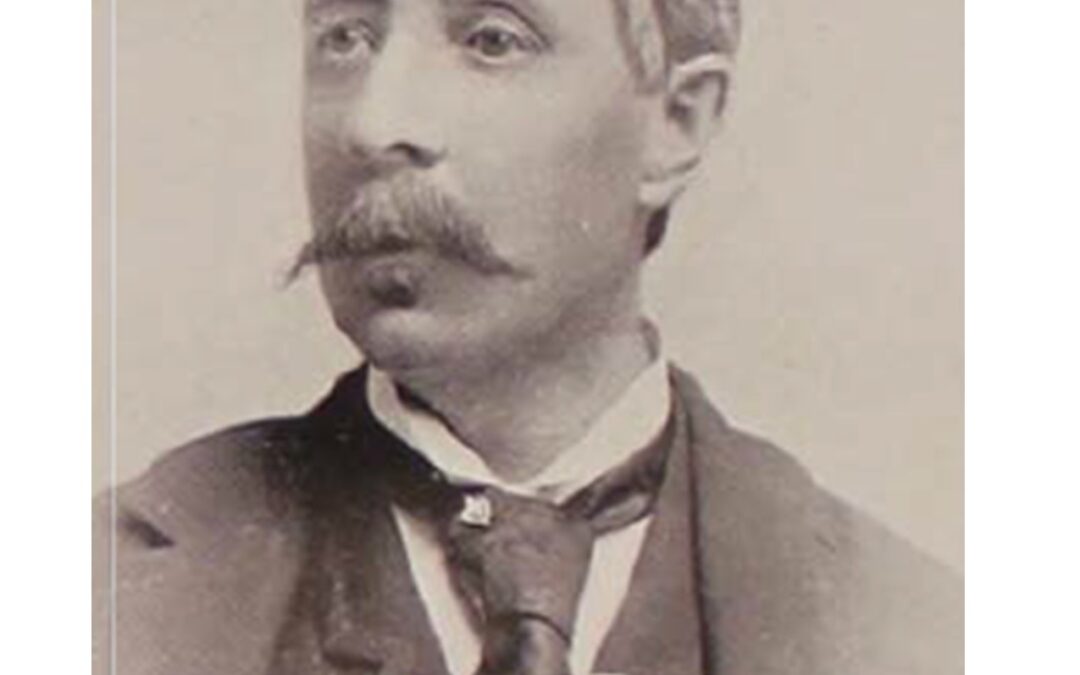
Frank T. Ripley was born in Bath, Maine in 1848 to shoemaker Edward Ripley and his wife Asenath. There is little information on his life, but he made Boston his homebase while he travelled the country for thirty years representing Spiritualism as a test medium.
By 1880, he was listed as a travelling Trance and Public Test medium in Spiritualism publications. By 1890, he was a regular speaker and medium for the Boston Spiritual Temple Society while he was in town. His travels took him throughout the northeastern portion of the country in the 1880s, gradually moving westward as Spiritualism flourished. In 1881, he reached Wisconsin and Colorado.
At an engagement in Rindge, New Hampshire, “Mr. Ripley’s tests were marvelous in their correctness, and were the theme of the conversation all over the grounds.” In 1892, he spent a month in Wonewoc, Wisconsin and recruited 50 people to join the Wonewoc Spiritual Association. The same year he travelled to St. Paul. According to M. T. C. Flower, president of The Alliance, it was published in the Banner of Light, 7 May 1892, “That he is a remarkable platform test medium goes without saying, as thousands of people can testify who have witnessed his public tests given from the rostrum at close of his lectures, and at the weekly test circles given in aid of the society.”
Frank’s travels took him to New Orleans, Grand Rapids, and as far west as California. In 1887 in Los Angeles, he was called “one of the greatest mediums of the present age.” The Los Angeles Herald wrote, “Mr. Ripley is a large hearted, whole souled man, one who at once inspires confidence in his hearers, and as he has been in such great demand throughout the eastern states, being engaged for months ahead, our association considers itself very fortunate in securing the services of Mr. Ripley. Each service will consist of a short inspirational address upon ‘The Philosophy of Spiritualism’ and after the address demonstrations of the same by giving his wonderful and convincing tests.”
In1900, The Courier-Journal, Feb 16, 1900 of Louisville, Kentucky, Rev. Dr. Frank T. Ripley was described as “the oldest test medium on the American platform. He spoke but a few moments, telling of the comfort he had derived from the teachings of spiritualism and from the feeling that when his friends passed away they would still be able to communicate with him In closing he said that he had learned that the future spiritual world would be material like the present world, but in it everything would be more refined and much purer.”
Frank’s life appeared to be a solitary one. There is no record of a wife or family. In 1900 in Allen, Indiana, he was listed as a single boarder. His life revolved around Spiritualism and his lectures included a 1910 talk in Buffalo entitled: “Spirit World Life and Labor There” and 1914 Elmira, New York lectures including “After Death, What?” and “What Shall I Do to Be Saved?”
frank in Jamestown, New York in 1914 after giving a lecture and readings and was said to be well-known in the city. He was buried by the Masons because no family could be found.

by | May 7, 2024 | Karen's Korner
Almon B. Richmond was born in Indiana in 1825, the youngest child of Lawton and Sarah Richmond. He was a direct descendant of John Richmond, a Puritan who arrived on the Mayflower. His father was a physician and surgeon whose practice extended throughout the countryside. After the family moved to Chautauqua, New York, Almon attended Allegheny college first taking medical courses and then studying law in Meadville, Pennsylvania.
He was admitted to practice in 1851 and had a long law career as a defense attorney, practicing in several states. The History of Crawford County published in 1885, states that he was involved in 4,000 criminal cases, 65 of which were homicides. By the time he retired in 1903, he had been involved with over 100 homicide cases.
Along with law, Almon was well versed in mechanics and the sciences. He was appointed assistant director of machinery at Crystal Palace in 1853. He also gave many lectures on philosophy, physiology, and chemistry. He was an advocate of the Temperance Movement and delivered many lectures on the topic. His books included Leaves from the Diary of an Old Lawyer, Intemperance and Crime, and Court and Prisoner.
Almon visited Cassadaga Lake (Lily Dale today) in 1887 and became interested in Spiritualism. He later wrote books entitled A Review of the Seybert Commissioner’s Report and Nemesis of Chautauqua Lake or Circumstantial Evidence, a fictional story. In the introduction, he writes: “Fiction is often truth colored by the brush or pen of the artist, or molded by the chisel of the sculptor.”
During the 1890s he was a regular lecturer at Cassadaga Lake and researched psychic phenomena and occult sciences. According to the Record-Argus, 19 July 1906, “He also lectured on many subjects and was for several years one of the most attractive personalities on the Spiritualistic lecture platform.” He also authored: “What I saw at Cassadaga.”
A lecture given by Almon at the Meadville Psychological Hallin 1889 entitled “The Dual Life; or, the Natural and the Spiritual Body” attracted a large crowd. He began by stating that the natural and spiritual body are in sympathy with each other. The Evening Republican reported that he said: “The belief that there is no hereafter is disloyalty to truth and treason to science.” It continued: “In telling what spiritualism has done and is doing, the essayist, among other things, said it confirms the faith of the Christian, and ignores the dark superstition of a hell.”
Almon published articles in the 1891book, Golden Way. He wrote in his “Immortality” article “If there is a spirit world, and if the spirits of those who have ‘passed away’ can and do visit the scenes of their earthly life they must all be governed by the laws that environ them in their new existence, and although any one may invoke their presence it is not certain that they will always come at their bidding. For this reason, set investigations by learned and honest committees may fail in obtaining results as satisfactory as those of the private séance or home circle.”
Almon retired from practice and moved to Pittsburgh in 1903 where he died at the home of his son three years later in 1906.
by | May 1, 2024 | Karen's Korner
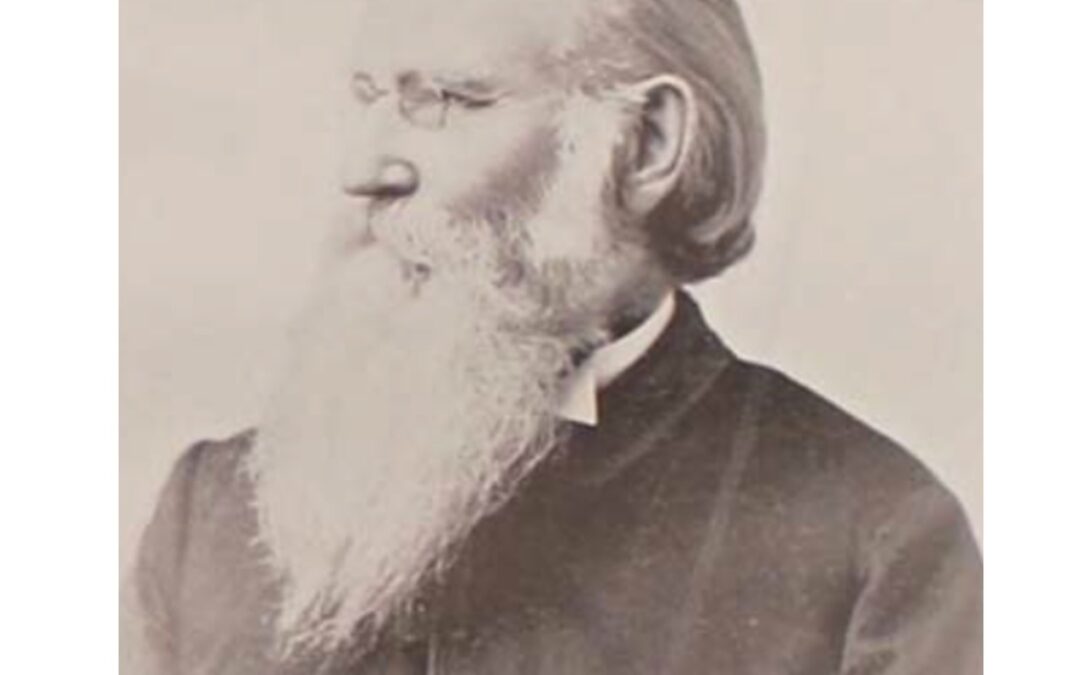
James M. Peebles was born in 1822 in Whitingham, Vermont, the oldest of seven children. According to a biography written by Edward Whipple in 1901, “From early childhood this boy was magnetic, genial, benevolent, and witty, but stubborn and capricious withal.”
James was educated in a little red schoolhouse. He had a serious speech impediment, but Professor Hurlburt helped him get over his stammer. When he was about 12, the family moved to Smithville, New York where they struggled to make ends meet. James did well with his schooling and was active in the Literary Society and Debating School. He taught a portion of the year to pay for his own schooling. After graduating at 16, he taught school in Picher, New York.
James questioned the teachings of traditional religion and searched for a belief system that wasn’t harsh and judgmental. The Universalists church was just beginning, and James saw a flier posted by Rev. N Doolittle and joined the church. James continued teaching and pursued his own education, including studying languages and medicine and eventually theology. He was only 20 years old when he became a reverend.
The last year of his pastorate in Kellogsville in 1845, he was invited by the Hon. Vincent Kenyon to ride to Auburn and hear the spirit rappings. James was impressed and began to read about other religious teachings like those of Swedenborg.
James married Mary M. Conkey in 1850. They had three children who died in childhood and the marriage did not last. In 1856, James accepted a pastorate in Baltimore at the Universalist Society, but the call of Spiritualism was not far behind. For 1853-55 he was pastor of the Universalist Church at Elmira, NY. But he was not happy with their beliefs and questioned his own. He eventually resigned and became acquainted with medium Charles Dunn who became his traveling companion in his Spiritualist ministry.
In 1861, James left for San Diego, California where he introduced himself to Rev. A. C. Edmunds, editor of The Star of the Pacific, a Universalist publication. James wrote several valuable articles for Edmunds and reported his experiences to the Herald of Progress. He also lectured throughout the state. He eventually returned to Battle Creek, Michigan a year later. Through Dunn and others, he contacted a very ancient band of spirits that directed his actions. He lectured throughout much of the country. In 1866, he became editor of Banner of Light.
James opened the Peebles’ Institute of Health in Battle Creek, Michigan. He advertised that if one would send in their money and symptoms, he would mail them a diagnosis and cures. In 1903, the Detroit Free Press published his conviction in the case illegal use of the U.S. Mail in a psychic healing business.
Despite his business problems, he published over a dozen books and many articles. Emma Hardinge wrote “By his scholarly writings, and indefatigable labors as a lecturer, Mr. Peebles has been a gigantic lever in moving public opinion in favor of spiritual belief, and the repudiation of the effete superstition of old orthodoxy. Being a writer, an author, a graceful and accomplished orator, Mr. Peeble’s services are in eager demand throughout the whole community….” He extended himself and traveled the world three times.
In his later years, Peebles divided his time between Battle Creek and Los Angeles. He died in California of a heart valve failure in 1922, just 36 days before his 100th birthday.
by | Mar 25, 2024 | Karen's Korner
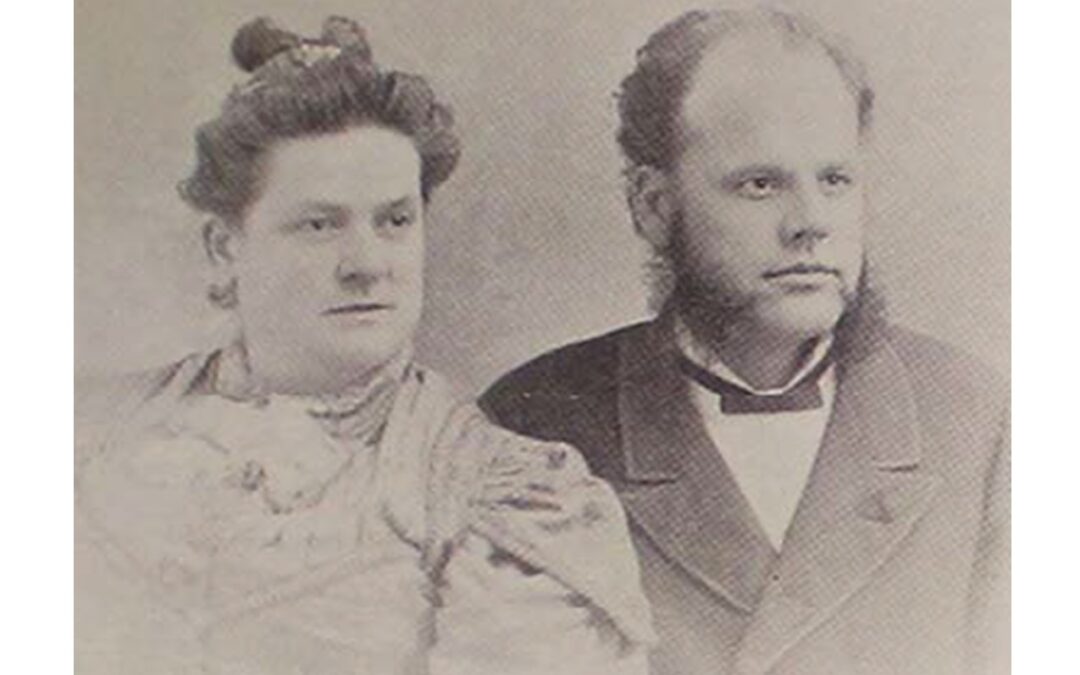
George Perkins was born in 1852 to Henry and Martha Perkins of Worcester, Massachusetts. He married Emiline Silvers, who was born in 1850 in New Jersey, in 1880. During the 1990s, the Perkins were active in in the Spiritualist community. George gave lectures in Boston and Chicago in 1891 and the next year he was joined by Emaline in Brooklyn, New York. At Maple Dell Camp it was stated that their participants included, “Brother George Perkins, musical director, speaker and test medium, and his good wife, who is also a good clairvoyant and test medium.”
In 1892, George published a new song book, The Spiritual Evangelist, that was “full of catchy melodies and appropriate hymns, for Spiritual meetings and circles.” By 1895, both George and Emaline were well-known platform test mediums who traveled through the northeastern United States, including Washington D.C.
At the 7th annual convention in Chicago, George was listed as musical director, a Spiritualist missionary and worked as an usher during the meeting. The Progressive Thinker, 28 October 1899, wrote, “I wish to say a word in commendation of Geo. F. Perkins, one of the most faithful and exemplary workers in this city, a man who stands without reproach and who is always faithful in the discharge of every duty that confronts him.” The article added, “Everyone who knows him and his wife knows there are no more faithful and conscientious laborers in the field, and also know that behind their mediumship is the element of character which is sometimes lacking in the more pretentious.”
During the late 1890s, Rev. George F. Perkins and Rev. Emaline Perkins led the Beacon of Light Spiritualist Church in Chicago. Two of their lecture topics were: “By Their Fruits Shall Ye Know Them” and “The Light of the World is Spirit.”
The Perkins moved west in 1900. In1901, George was listed as a singer, lecturer, and medium at the California state convention in San Francisco. Emeline passed in April of 1904 in San Francisco, and George resumed his lecture meetings at Odd Fellows Hall, San Fransico later that year. In 1905, he spoke and gave readings several times at the Union Spiritual Society in Oakland, presenting lectures on topics such as: “The Divine Three of the Origin of the Holy Trinity” and “Character.”
In 1906, George wrote to the Oakland Tribune, 25 Nov 1906, “Don’t you think the evangelists Simpson and Hibbard, at the Advent tent on Broadway, are over-stepping the boundary line of propriety and courtesy when they nightly abuse in the most emphatic language everybody and any organization that does not come under their particular endorsement? For weeks these men have used up all the dictionaries searching for words to express their contempt for every other religious denomination, more particularly the Roman Catholic and Spiritualists. And the President of the United States and our government do not escape their vitriolic tongues. Everyone has a right to advocate his conception of the truth and principles as set forth in the Bible, but I question any one’s right to insult and abuse all who do not conscientiously agree with them on these puzzling questions.”
George lived until at least 1930, when he was listed as a retired widower living in a rooming house in Oakland, California.
by | Mar 25, 2024 | Karen's Korner
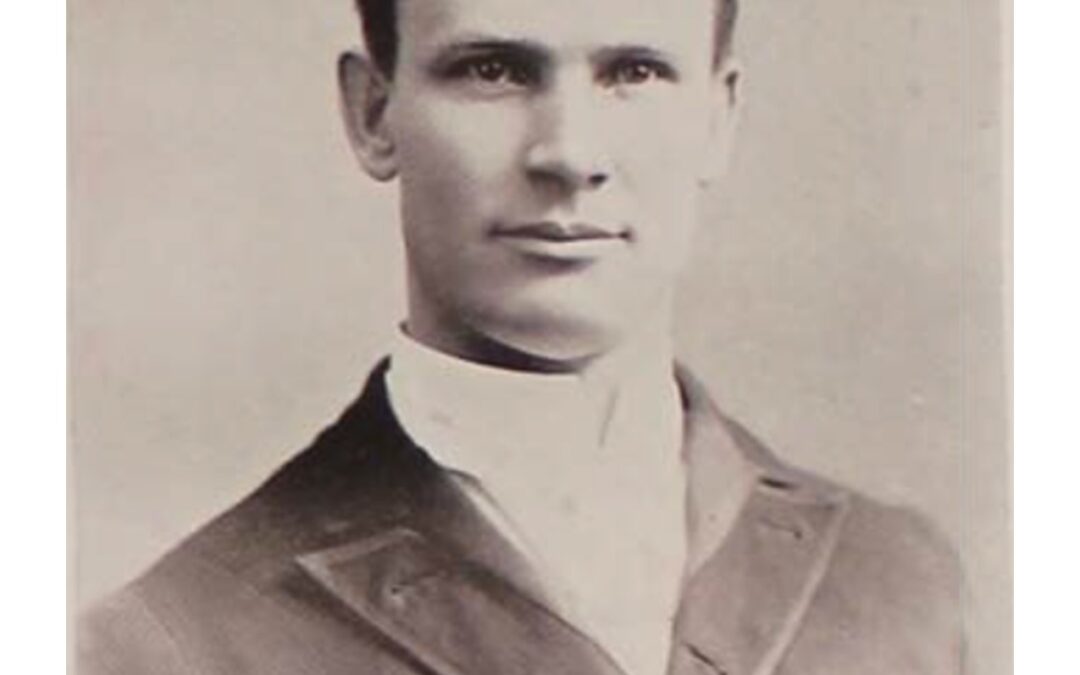
William A. Mansfield was born in 1859 to farmers Amos and Ann Mansfield in Ravenna, Michigan. He became one of the best-known slate writing mediums in the country. According to The Akron Beacon Journal, July 21, 1893, He “has an extensive acquaintance in spiritual circles and is honored and respected everywhere. He is yet a young man but has been before the public for 11 years in his chosen work. He spent two years in the Bryant & Statton business college in Buffalo, after which he went to Boston, where he spent two years in the college of oratory, graduating from that celebrated institution in 1889. He is now a junior in the Huron Street Hospital College at Cleveland. Mr. Mansfield has traveled extensively and has visited nearly all the large cities in the United States.” An1890 advertisement stated that: “William A. Mansfield. Medium for Independent Slate Writing, Hotel in Boston, Private sittings. Private Home Circles.”
William’s 1893 wedding was held at Brady’s Lake Spiritualist Camp according to the The Akron Beacon Journal, July 21, 1893. “The bright, warm sun, as it rose from the east yesterday morning, peeped through the tall and stately forest trees at Lake Brady, and cast occasional rays down on a happy, expectant throng, which was assembled to witness an interesting ceremony, one seldom celebrated at a summer resort. It was nothing more or less than a marriage ceremony, in which a well-known, popular and beloved member of the spiritual camp led to the altar a handsome, charming young girl from Michigan. The groom was Will. A. Mansfield and the bride Miss Lenno A. Moray, both of Grand Rapids, Mich.” His brother John Orton Mansfield was a groomsman. About 250 people attended.
A son was born to the couple in 1894 and a daughter in 1895. William presented lectures and conducted slate writing at Lily Dale, Grand Ledge Spiritualist’s Camp in Michigan, and Maple Dell Park in Mantua, Ohio in the 1890s. In 1897, at Maple Dell Park, he “gave a light séance for physical manifestation.” He spent the season at the camp.
William advertised in Light of Truth: “Homeopathic Treatment compounded clairvoyantly for each case. Send name, age, sex, leading symptoms for Free Diagnosis and ‘Methods of Cure.’” Another advertisement stated: “Dr Mansfield. Homeopathic treatment compounded clairvoyantly for each case. Send name, age, sex, leading symptoms for free diagnosis and methods of cure. Cedar avenue in Cleveland.”
By1900, William was a widower living with his daughter at his brother John’s home in Cleveland. He moved to Barberton, Ohio where he was health commissioner for 25 years. By 1930, he had been suffering from an illness for two years. The 1930 Akron Beacon Journal reported on William’s death at the age of 72 as a suicide, using exhaust fumes from his automobile.
by | Mar 25, 2024 | Karen's Korner
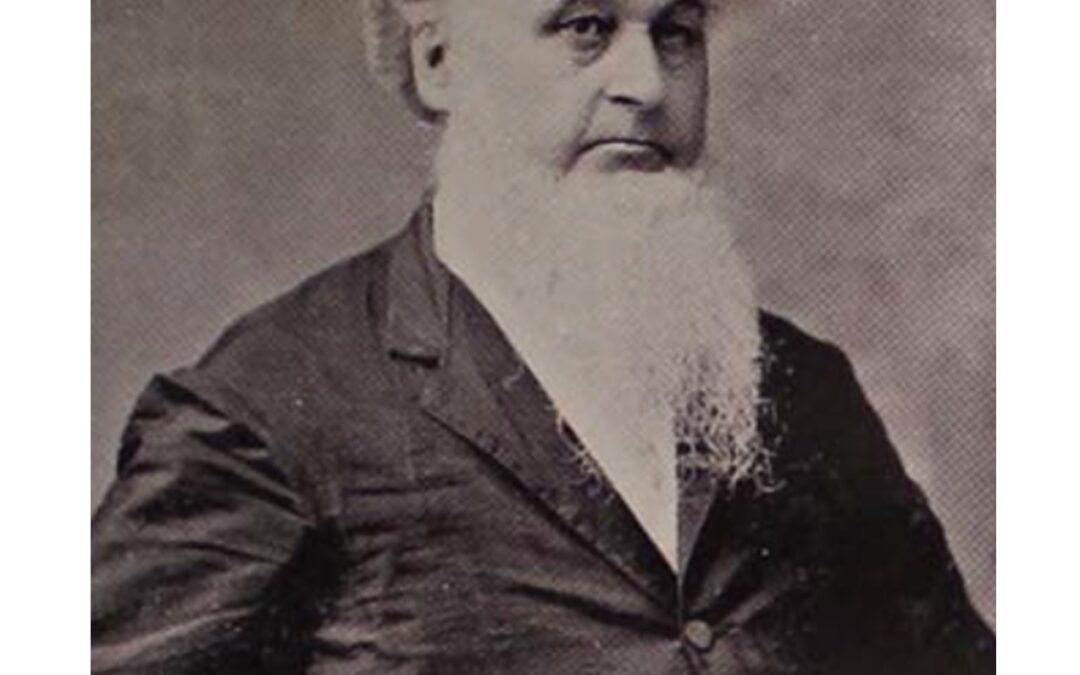
James V. Mansfield was born in Dudley, Massachusetts in 1817 to farmers Jera and Lucretia Mansfield. The family claimed to be related to Lord Mansfield who rid England of Slavery. James’ ability as a medium started at an early age when he began seeing spirits. He suffered from a sickness during his teen years and was thought to be close to death seven times. He was an avid reader during his sickness, but never received any schooling until after he recovered at the age of twenty. He attended an academic school for about six months, studying English. After that, he became a clerk at a country store until he was 22.
James married Mary Hopkinson in 1847 and they had three children. They endured many financial struggles, and he was impelled at times to travel in search of work. He taught penmanship in Virginia and the Carolinas before returning to the store where he worked for several more years.
After moving to Boston, James became a prominent member of the Spiritualist movement. He was listed in the fourth Annual Spiritualist Register in 1860, provided spirit communications through letter writing, and earned the title, “spirit postmaster.” Those who wished to communicate with the departed could have a séance with him in person or mail a letter to the spirit in care of Mansfield. In the latter case, he would provide answers to unopened letters. He granted sittings if they didn’t interfere with his regular work. After some time, he became so popular that he decided to make mediumship his business.
James left Boston to travel, visiting the major cities in the eastern United States. Then he went to the Pacific coast and remained there for three years. While he traveled, he wrote home to his wife. His letters to her totaled over 16,000 pages. From 1866-1869, he also responded to 31,000 letters, 21,000 which were written and sent free, without any payment or any demand for payment. According to the Banner of Light, “As the answers he sent are written very coarsely on printing paper, postage stamps form no inconsiderable item in these expenses, sometimes as high as twenty cents being put upon one letter….”
Mansfield was both admired and disdained for his “talents.” He also referred to himself as a “test medium,” providing free communications for skeptics. In 1885, he was studied by the University of Pennsylvania’s Seybert Commission, which was established to investigate spiritualist phenomena. After observing him, Dr. Horace Howard Furness of the Commission concluded in the official report that he was at best a charlatan.
Others stood by him. In the Banner of Light, 7 November 1885, Vol. 58, No. 8 it stated, “Of the many whom we have personally known to have tested his mediumship, we can refer to a no less experienced and accurate an observer then Rev. John Pierpont, who frequently, during his earth-life, held private seances with Mr. Mansfield and received such undoubted evidence of his mediumship as to go far toward firmly convincing him of the truth of Spiritualism.”
James Mansfield died 1899 in Ipswich, Massachusetts at the age of 82. He wrote to Mr. Jay Chaapel, “I have been trying to live for the last half century to make the world better from my having lived in it, but if so it remains to be seen….Forty-six years have I labored for Spiritualism, and have never rusted. I have written 700,000 communications in 15 different languages on paper five inches wide to three and a half feet in length, which, if pasted together, would have extended twice around the globe. My public labors have ended, though with few exceptions, I do write for packages from abroad occasionally. I have lost the sight of my right eye, have but partial use of my right arm, and my lower limbs have become almost useless from paralysis. I am 82 years old, have no fear of death and have been looking forward for the change the last ten years.”