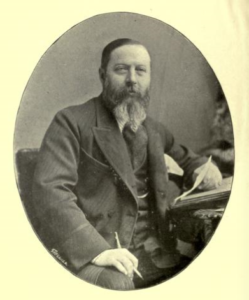
 William Stainton Moses was born in Donnington, Lincolnshire, England in 1839. His father was the head master of a grammar school, so it is not surprising that Moses excelled in academics. After entering Exeter College in 1858 he became too ill to complete his studies. He spent a year travelling on the Continent with friends to recuperate, staying six months at the Greek Monastery, “Mount Athos.” He eventually returned to England and completed his degree in 1863.
Even though his health improved, a doctor insisted he live in a rural setting. He accepted a position aiding a parish priest at Maughold, Isle of Man and stayed there five years. In the spring of 1868, he accepted another position at St George’s, Isle of Man. It was there that he met Dr. and Mrs. Stanhope Speer, who nursed him back to health after a bout of liver disease. He ended up moving to London and stayed with the Speers for nearly a year.
It was during his time with the Speers in 1870 that the subject of Spiritualism was discussed. Dr. Speer had no interest in the subject and Moses regarded it as trickery and fraud, but he promised Mrs. Speer that he would investigate the subject. His first experiences with Spiritualism were with Lottie Fowler in 1872. After a few visits, he persuaded Dr. Speer to attend a session. They were soon convinced that some force outside the medium existed.
Concurrently, Moses’s own mediumistic powers began to develop. During his seances, multiple kinds of manifestations took place: spontaneous rapping, raps which answered questions, illuminated globes and other lights, various scents, musical sounds and ringing chimes, moving objects such as tables and chairs, apports, and direct spirit voices. Mrs. Speer recorded all happenings during his seances.
Moses began to manifest automatic writing in August of 1872. In the following month, direct writing was produced with the name “Imperator” written on it. The Imperator spoke for the first time by direct voice a few days later. By the time of his death, Moses had composed twenty-four books containing information given to him from the Imperator over a ten-year period.
“We deal with religion as it affects us and you in simpler sort,” he wrote. “Man–an immortal spirit, so we believe–placed in earth-life as a school of training, has simple duties to perform, and in performing them is prepared for more advanced and progressive work. He is governed by immutable laws, which, if he transgresses them, work for him misery and loss; which, also, if respected, secure for him advancement and satisfaction.”
Frank Podmore, author and founding member of the Fabian Society was known for his skeptical writings on mediums and spiritualism. Podmore said that Moses’ personality did not suggest he was a fraud, and he didn’t think Moses showed any mental abnormality. Frederick W.H. Myers testified to Moses’ ‘manifest sanity and probity’. Charlton Speer, confirmed that seance phenomena occurred some distance from Moses, that noises were heard from different heights, and lights approached from the opposite location of where Moses was seated.
Moses was a member of the British National Association of Spiritualists, launched the London Spiritualist Alliance, and was its President at the time of his death. He was editor and contributor to Light, wrote for Human Nature and the Spiritualist, and assisted in the formation of the Ghost Club. He published Researches in Spiritualism (in Human Nature, 1874-5), Psychography (1878), Spirit Identity (1879) and Higher Aspects of Spiritualism (1880). He suffered from persistent ill-health most of his life an died in 1892 from Bright’s disease (chronic inflammation of the kidneys).
Additional reading:
Stainton Moses, W. (1952). More Spirit Teachings. London: Spiritualist Press.
https://meilach.com/spiritual/books/st/spteach.htm