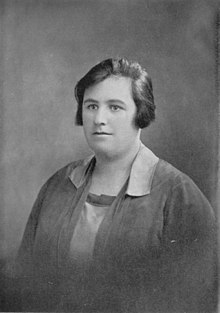
Helen Duncan was born in Perthshire, Scotland 1897, the fourth child of Isabella and Archibald MacFarlane. Helen began to exhibit psychic abilities when she was a young girl. One time at school, the answers to quiz questions appeared on her classroom slate in another person’s hand writing.
When she was only sixteen, Helen left for Dundee to find employment. She worked in an ammunition factory during World War I, then at a jute factory and later as a nurse. She was introduced to Henry Duncan, who remarked when they met, “So we meet at last.” Both had apparently had visions of each other before hand.
Henry was exposed to rheumatic fever and had a badly damaged a heart valve. Despite that, they married in May 1916 and he worked as a cabinet maker while Helen gave birth to their six children. Helen supplemented their income by doing mending and laundry.
After suffering a heart-attack, Henry stopped working full-time. He encouraged Helen to develop her psychic talents. She would often go into a trance state. At one point, a spirit guide named Dr. Williams told Henry that Helen could materialize spirits. Her first seances were unpredictable, but Dr. Williams advised them. Henry made a cabinet with black curtains for her to use during her trances. Soon, she was producing ectoplasm as well as spirits which could only be observed in dim red light according to Dr. Williams.
Albert Stewart became Helen’s second spirit guide. He had been born in Scotland and emigrated to Australia where he had drowned in 1913. With Uncle Albert’s help, Helen was much in demand, and held regular seances at The Scottish Spiritualist Society in Edinburgh.
In 1931, Helen agreed to let Mr. Harry Price witness and test her psychic abilities. Price was a cynic who was determined to prove that Helen was a fraud. He attended several controlled séances. At one point, he took a sample of ectoplasm which dissipated in the bottle. He concluded that she used trickery and regurgitated cheesecloth to create ectoplasm.
During a 1934 séance in Edinburgh, a sitter grabbed at one of Helen’s spirit guides. The resulting turmoil led to the police being called. At Edinburgh Sheriff Court, Helen was accused of affray and fraud. She pleaded not guilty. Three of the eight people attending the séance spoke of her behalf. Helen was sentenced to pay a ten shilling fine.
Helen’s popularity and reputation continued to grow through the 1930s and 1940s. After World War II broke out, the demand for séances was even higher. Unfortunately, Helen’s accuracy got her into trouble. During a séance in 1939, Uncle Albert claimed a British battleship has sunk. This was information that the British military wanted to keep out of the news. The Admiralty sent two officials to question her. The authorities grew concerned that she was a potential security risk.
Despite this, no action was taken against Helen until January 1944 when practice for D-Day was underway. It was feared that the spirit of a soldier who had died during a failed practice run might give away their plans during a seance. Helen was raided by the police and first arrested under section 4 of the Vagrancy Act 1824, a minor offence. Later, she was charged with section 4 of the Witchcraft Act 1735, covering fraudulent spiritual activity, which would be tried before a jury.
The trial lasted from March 23rd to April 3rd. Even though the prosecution produced only five witnesses and the defense forty-nine, Helen was found guilty. Chief Constable West described Helen as a “national pest and unmitigated humbug” and divulged that she had disclosed the sinking of the two ships before they were public knowledge. She was sentenced to nine months at Holloway prison, which was reduced to six months. Helen was one of the last women to be convicted under the Witchcraft Act of 1735. In 1951, the act was repealed partly due to pressure from Winston Churchill.
If Spiritualists thought they were safe from intimidation and prosecution, they were wrong. In 1956 another one of Helen’s séances in Nottingham was raided by police. During that raid, Helen was interrupted while producing ectoplasm. When this happened, the ectoplasm returned to Helen’s body too quickly. Two second degree burns the size of saucers appeared on Helen’s stomach and breast. She was examined by a doctor and rushed to the hospital in severe pain and shock. The burns never healed. Helen passed away five weeks later on the 6th of December 1956.
Additional reading:
Roberts, C.E. Bechhofer (1945) The Trial of Mrs. Duncan. Jarrolds Publishers, London
If you liked this blog, check out my blog collection, Treasures from the Spirit World.
thank you so much, Karen, for highlighting these wonderful mediums – bxx
Thank you ❤️